Setting road & parking prices
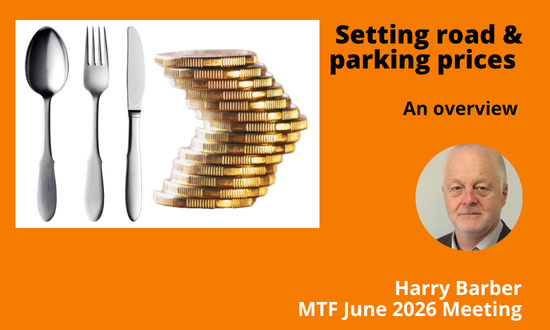
Setting road & parking prices was the topic of Harry Barber’s presentation at the MTF meeting 3 June 2026.
He explores the use of road and parking pricing to promote behaviour, deter behaviour or to target behaviour change.
Much of the discussion is about case examples from around the world.
The presentation was designed for council officers and councillors.
Summary
Harry Barber discusses three types of pricing strategies for transport: the spoon, the knife, and the fork.
The “spoon” price aims to raise revenue and is characterized by inelasticity, meaning price changes don’t significantly alter behavior. Examples include Stockholm’s cordon charge, which funds a bypass, and Manhattan’s congestion relief zone, which services subway debt. Randwick is also planning a spoon price for beach parking to fund beach maintenance. Spoon prices are often set by finance departments, are uniform across a system, and tend to increase over time.
The “knife” price is designed to cut unwanted behaviors and is elastic, meaning it encourages behavioral change. Examples include Ireland’s plastic bag tax, which reduced bag usage, and pollution charges in European cities like London, which aim to reduce emissions. Milan’s pollution charge is noted as a “blunt knife” due to numerous exemptions.
The “fork” price optimizes system usage by adjusting prices based on demand, aiming to keep the system within its capacity. Singapore uses a fork price for roads to maintain optimal traffic flow, and Seattle applies it to parking to ensure availability. These prices vary by time of day and location, increasing during peak demand and decreasing during off-peak hours. The goal is not revenue, but efficient system operation.
RECENT POSTS
TRAP
Traffic related air pollution in urban environments presentation by A/Prof Vicki Kotsirilos AM. April 2025
IV: Fast, frequent, fair
5 June meeting with presentation by Infrastructure Victoria on "How buses can better connect Melbourne."
Apartments and PT GROWTH
1 May 2024 meeting with presentation from RMIT CUR on apartments and PT growth
State budget review
The State and Federal budgets were the topic of a panel discussion involving council transport analysists, rail experts and a transport reporter from a major news outlet.
Councils & DTP
DTP and Council working together on Active Transport was the main topic of discussion at the May meeting.
IV SAYS GET ON BOARD
Get on board: Making the most of Melbourne's buses is a discussion paper
presented by Infrastructure Victoria's Peter Kartsidimas
CASE STUDIES
MTF's February meeting heard two presentations from local planners who have looked at overseas examples of urban transport planning.
Congrats to speakers
Congratulations to the successful candidates and MPs who participated in one of our MTF Transport Forums before the election.
All FORUM VIDEOS
Eight MTF Transport Forums were held across Melbourne in July - October 2022